January 28, 2026 |
The most honest expression of everyday Tunisian life
Some foods ask for time, tables, and long conversations. Tunisian sandwiches belong to another rhythm entirely. They are made for movement, for hunger solved between errands, for early mornings near school gates, for short breaks taken in parked cars, and for seaside pauses that turn into shared moments. They are simple, unpretentious, and deeply personal.
In Tunisia, bread is never just a container. It is the starting point of flavor. Once it meets heat, olive oil, cheese, tuna, or harissa, it becomes one of the country’s most sincere culinary expressions.
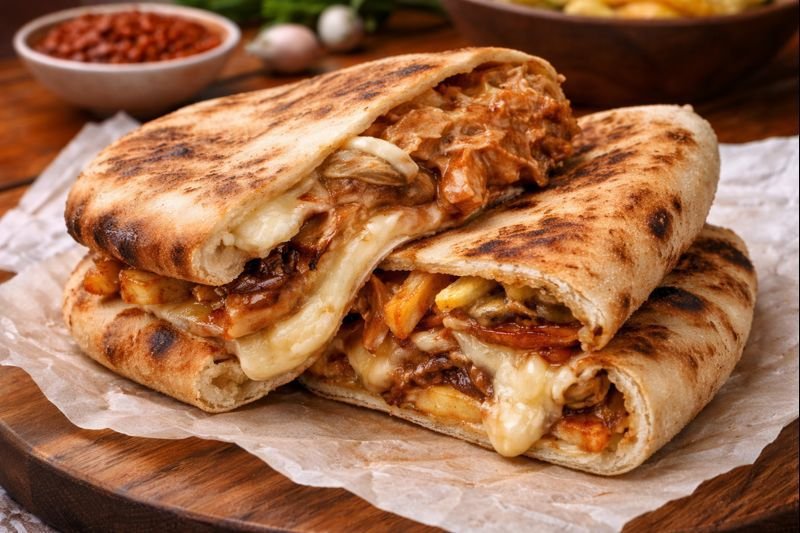
A good makloub is warm even before the first bite. It arrives wrapped in thin paper, steam trapped inside. The bread stays soft and flexible, holding grilled chicken or merguez, unevenly melted cheese, and a vivid streak of harissa. As it presses against the grill, a gentle sizzle begins. Minutes later, dark lines mark the outside while the inside remains tender.
No one ever waits long enough before biting in. Lips burn slightly, cheese stretches, and the bread leaves its scent on your fingers long after the sandwich is finished.
Makloub tastes like youth, like long afternoons, like hunger satisfied instantly. It is comfort served quickly, without apology.
Tabouna bread carries the soul of clay ovens. When it emerges, its surface is lightly blistered and its aroma smoky. Opening it feels like opening something alive and warm. Inside go tuna soaked in olive oil, slices of potato, sometimes grilled meat, and always a red mixture made from crushed peppers.
Tabouna sandwiches belong to roads and open air. They are eaten with elbows resting on car windows, fingers dusted with flour, the wind carrying crumbs away. The bread leaves a faint trace on the lips, soft and smoky.
It is simple food, prepared with care rather than excess.
Mlawi is bread you recognize instantly. Its folds reveal the hands that stretched it. Some layers crisp while others stay soft and buttery. No two mlawi are identical, and that irregularity is its beauty.
Inside mlawi, ingredients settle naturally. Eggs with parsley feel at home. Cheese melts into pockets. Tuna spreads gently with olive oil. The sandwich feels less like street food and more like a home meal eaten outdoors.
On cool evenings, mlawi warms the hands before it ever reaches the stomach.
Lablebi is traditionally a bowl, meant to be eaten slowly with steam rising. Yet Tunisia found a way to hold that comfort in the hands. A baguette is warmed, opened, and filled with hot chickpeas. Olive oil flows in. Harissa stains one side red. A boiled egg breaks softly into the mixture.
Nothing about it is elaborate. Yet it carries the same emotional weight as the soup. It is the sandwich of early mornings, of gentle hunger, of kindness offered without words.
One bite is enough to bring calm.
Fricassé is small, yet complete. The dough is lightly fried so it stays soft, yielding gently when pressed. Inside are familiar companions: tuna, potato, egg, olives, sometimes capers.
It often appears on trays at family gatherings. Children reach for one too early. Adults notice and pretend not to. Eating fricassé feels like stepping into a shared moment.
It disappears quickly, but it leaves satisfaction behind.
Kafteji begins with rhythm. Fried vegetables chopped rapidly, the sound of the knife echoing like percussion. Placed inside bread, the mixture shines with olive oil. The sandwich is warm, colorful, slightly messy, and full of life.
It is eaten standing, leaning against walls or sitting on curbs. Napkins are never enough. It tastes bright and bold, like sunshine folded into bread.
The final bite always carries more heat than the first.
The stuffed baguette is Tunisia’s most practical companion. Lined up behind glass in cafés and shops, wrapped neatly and ready to go. Tuna, potato salad, olives, cucumber slices form a familiar structure.
Students take it on buses. Employees eat it at desks. Drivers unwrap it at traffic lights. It is chosen not for excitement, but for reliability.
It does not surprise. It reassures.
Tunisian sandwiches are everyday poetry. They do not need ceremony to matter. They arrive warm, sometimes imperfect, wrapped in thin paper, eaten quickly. Yet they offer something lasting: comfort, fullness, a sense of place.
They represent Tunisia at its most human.
Food made quickly, but never carelessly.
Food prepared simply, but never without soul.
Food eaten casually, but remembered honestly.
In the careful folding of bread, the gentle spreading of harissa, the warmth passed from hand to hand, Tunisia reveals itself. Quietly, generously, and with a warmth that lingers long after the final bite.