January 28, 2026 |
Where earth becomes memory and hands carry time
Pottery in Tunisia is not an object you admire from a distance. It is something you live with. It holds water, cools food, stores grain, receives flowers, and rests quietly in corners of homes. Long before it entered galleries or markets, pottery shaped daily life. It was born from need, refined through repetition, and preserved through memory rather than instruction.
Across Tunisia, clay has always been close. The land offers it generously, and people learned early how to listen to it. Tunisian pottery does not aim for perfection. It aims for truth. Each curve reflects the pressure of a hand. Each surface carries the trace of fire, wind, and time.
In the northwest, near the forests of Sejnane, pottery takes its most ancestral form. Here, Amazigh women work with clay exactly as their ancestors did, without wheels, without kilns, without written patterns. The earth is gathered locally. The shaping happens entirely by hand. The firing takes place in open air.
The pottery of Sejnane is immediately recognizable. Rounded forms. Earth toned surfaces. Decorations drawn from nature: lines, dots, symbols inspired by animals, plants, fertility, and protection. Black, ochre, and reddish hues dominate, created not by paint, but by smoke and mineral content.
These pieces are not decorative experiments. They are cultural statements. Water jugs, bowls, cooking vessels. Objects designed for use, then elevated by meaning. Each piece carries the rhythm of women sitting together, shaping clay while exchanging stories, knowledge, and silence.
This tradition is so deeply rooted that it has been recognized internationally as intangible cultural heritage. Yet in Sejnane, it remains simply life.
Further east, in Nabeul, pottery tells a different story. Here, clay meets glaze. Fire becomes controlled. Color enters with confidence.
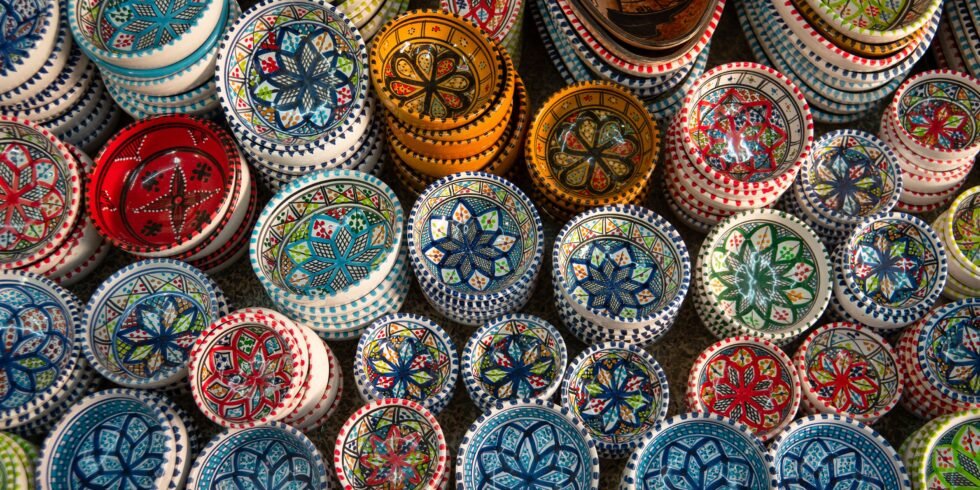
Nabeul pottery reflects centuries of exchange. Andalusian influence appears in geometry. Ottoman heritage lives in floral motifs. Mediterranean light shapes the palette. Plates, bowls, tiles, and vases emerge bright and expressive, painted in blues, yellows, greens, and reds.
Unlike Sejnane’s raw earthiness, Nabeul pottery embraces symmetry and decoration. Yet both share the same foundation: patience, repetition, and respect for material. Each painted line is applied by hand. Each piece passes through fire knowing it will never return the same.
Beyond named centers, pottery exists everywhere in Tunisia. In villages, plain clay jars cool water naturally. Large storage vessels hold olive oil and grain. Cooking pots distribute heat slowly, giving stews their depth.
These objects are rarely labeled as art. They are trusted tools. Their beauty lies in how well they work. A chipped edge does not diminish value. It adds history.
In many households, pottery is inherited. A bowl from a grandmother. A jug used for decades. These pieces stay because they still serve.
Pottery is always an act of risk. Clay may crack. Fire may distort. Color may shift. The artisan accepts this uncertainty. Control exists, but domination does not.
In traditional firing, especially in Sejnane, flames move freely. Smoke settles unpredictably. Each piece emerges unique. In more structured kilns, as in Nabeul, precision increases, but surprise never disappears completely.
This balance between intention and acceptance defines Tunisian pottery. The artisan guides. The earth decides.
Pottery survives in Tunisia because it adapts without forgetting. New forms appear. Old symbols remain. Some pieces are now made for travelers rather than kitchens, yet the techniques remain authentic.
Buying handmade Tunisian pottery supports more than an object. It supports local economies, female artisanship, environmental sustainability, and knowledge passed through practice rather than institutions.
In an age of uniform objects, Tunisian pottery insists on variation. No two pieces are identical. That is not a flaw. It is proof of life.
To hold a Tunisian pottery piece is to hold earth shaped slowly. It carries the weight of soil, the heat of fire, the memory of hands that worked without hurry. It belongs equally to the past and the present.
These objects do not ask to be admired endlessly. They ask to be used, trusted, lived with.
Tunisian pottery reminds us that beauty does not need precision, and durability does not require noise. It teaches that culture survives not through preservation alone, but through daily contact.
And long after other objects are replaced, clay remains. Quiet. Functional. Human.
That is the strength of Tunisian pottery. Not perfection, but permanence shaped by hand.