January 28, 2026 |
Where heat, patience, and identity are ground into one paste
Harissa is not simply a condiment in Tunisia. It is presence. It lives quietly on the table, never announcing itself, yet always shaping the meal. Its red settles beside bread and olive oil. Its scent rises softly from stews and sauces. Its heat does not shout. It builds, warms, and stays. To know Tunisian food is to understand harissa not as spice, but as language.
There is a rhythm to harissa that mirrors the country itself. Sun ripens peppers. Hands dry them patiently. Mortars wait. Oil seals memory. What emerges is not aggression, but balance. Heat carried with intention.
Tunisia’s climate gives chili peppers exactly what they need. Long sunlight, dry air, and time. From the Cap Bon region around Nabeul to inland towns near Kairouan, peppers grow slowly, developing sweetness alongside heat. They are not rushed. They are not oversized. Their flavor concentrates naturally.
When harvest ends, peppers are split and laid out under the sun. Rooftops, terraces, and courtyards turn red. The drying is deliberate. Too fast and flavor collapses. Too slow and bitterness settles. Experienced hands know when the peppers are ready. They bend without breaking. Their color deepens into rust.
This drying stage matters as much as any spice added later. It determines whether harissa will be sharp or rounded, fiery or warm.
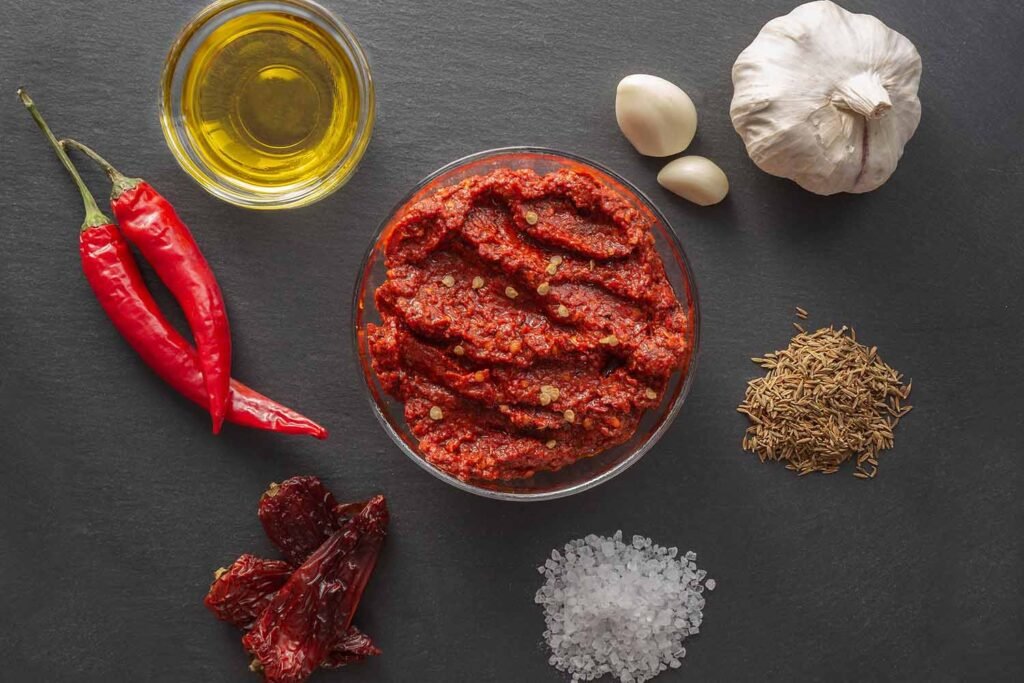
Harissa begins with sound. The dull rhythm of pestle against mortar. Dried peppers soften slightly before being ground with garlic, coriander seeds, caraway, sometimes cumin. Each family adjusts ratios instinctively. No recipe is written. Measurements live in memory.
Olive oil is added slowly, not to dilute, but to bind. Salt anchors the mixture. What results is thick, textured, alive. The paste holds grain. It resists smoothness. Industrial uniformity is not the goal. Character is.
In many households, harissa is prepared once or twice a year. Large quantities are made together. Conversations flow. Children learn by watching. Elders correct gently. Jars are filled and sealed with a final layer of olive oil, protecting the paste through months of use.
This is not production. It is preservation.
Harissa appears everywhere, yet never dominates. A small spoon stirred into soup deepens warmth. A streak across grilled fish lifts sweetness from the sea. Mixed into salads, it brightens vegetables without masking them. Spread lightly on bread with olive oil, it becomes breakfast.
In dishes like ojja, kafteji, lablabi, couscous, and seafood sauces, harissa acts as structure rather than decoration. It connects ingredients. It carries heat evenly. It defines Tunisian flavor more than any single spice.
Importantly, Tunisian harissa is not about burning the mouth. Heat is calibrated. It arrives gradually, settles in the throat, and fades cleanly. The goal is comfort, not challenge.
Harissa changes subtly from region to region. In coastal areas, it leans smoother and milder, pairing easily with fish. Inland versions are darker, thicker, and warmer, designed for stews and meat. Some families add dried tomatoes for sweetness. Others rely on pepper alone.
In Nabeul, harissa production became a craft industry, supplying markets across the country. Yet even here, the most respected harissa remains homemade. The kind that stains fingers and smells of sun.
What unites all versions is restraint. Harissa is never loud. It is confident.
Harissa carries memory in a way few foods do. Its smell alone can recall kitchens, seasons, people. Many Tunisians remember the day harissa was made each year. The piles of peppers. The red dust on hands. The jars lined up to cool.
It is present at celebrations and at ordinary meals. It marks Ramadan tables. It sits beside bread offered to guests. It accompanies grief and joy without distinction. Harissa does not choose moments. It belongs to all of them.
For a long time, Tunisian harissa traveled anonymously. It was exported without name, blended, diluted, or rebranded. That is changing. Today, Tunisian harissa is increasingly recognized for what it is: a balanced, heritage product shaped by climate and craft.
Protected designations, artisanal labels, and small producers are reclaiming authorship. Quality harissa is now identified by its ingredients, texture, and method, not just its heat level.
Choosing authentic Tunisian harissa supports more than flavor. It supports small producers, seasonal agriculture, and a food culture built on patience rather than shortcuts.
There is a moment when harissa is added to a dish. Not poured. Not spread thickly. Just touched in. That moment defines Tunisian cooking. It says enough.
Harissa is not excess. It is measure. It teaches that heat can be gentle, that intensity can be balanced, that strength does not need volume.
To taste Tunisian harissa is to understand Tunisia itself. A country shaped by sun, sharpened by restraint, and generous without noise.
Harissa does not dominate the table. It anchors it.
And like all things essential, it is always there, quietly red, patiently waiting to be used with care.