January 28, 2026 |
Along the tranquil coasts of northern Tunis exists a locale where cultures flourished, empires fought, and myths originated. Carthage, formerly the illustrious capital of a vast Mediterranean empire, continues to be one of the most captivating places in Tunisia, an outdoor gateway to the remarkable realm of the Phoenicians and Romans, as well as a representation of the Tunisian essence that has persisted for almost three thousand years.
In the 9th century BCE, Carthage originated as a Phoenician trading outpost established by Tyrian settlers. In line with beloved custom, its origin is linked to the tale of Queen Dido, or Elissa, who escaped her country and bargained for territory “no bigger than an oxhide.” By cutting the hide into narrow pieces, she acquired sufficient land to create the city’s initial fortress on Byrsa Hill. Regardless of its status as legend or fact, the story embodies the creativity and drive that would shape Carthage’s identity. The site of the city was selected with remarkable anticipation. Positioned by the Mediterranean, adjacent to vital trade paths, and encircled by rich plains, Carthage rapidly evolved from a small community into a dominant maritime and trading hub. Its traders engaged in commerce throughout Africa, Europe, and the Middle East; its engineers created some of the most advanced ports of ancient times; and its seafarers became experts in navigation. A lively, diverse society developed, anchored in Phoenician heritage but enhanced by North African and Mediterranean elements.
With the expansion of Carthage’s wealth and influence, it inevitably faced the ascendant power of Rome. Their competition led to the intense Punic Wars, historical events marked by brilliance and sorrow. Hannibal Barca, the most renowned general of Carthage, etched his name into history by his bold journey across the Alps with his troops and elephants
Although the city ultimately fell to Rome in 146 BCE, its narrative continued. Restored a hundred years later, Carthage thrived again. This time, it is one of the most radiant gems of the Roman Empire. Its theaters, villas, bathhouses, and forums reflected a revitalized golden era. Initially a Punic capital and later a Roman metropolis, Carthage transformed while retaining its core identity.
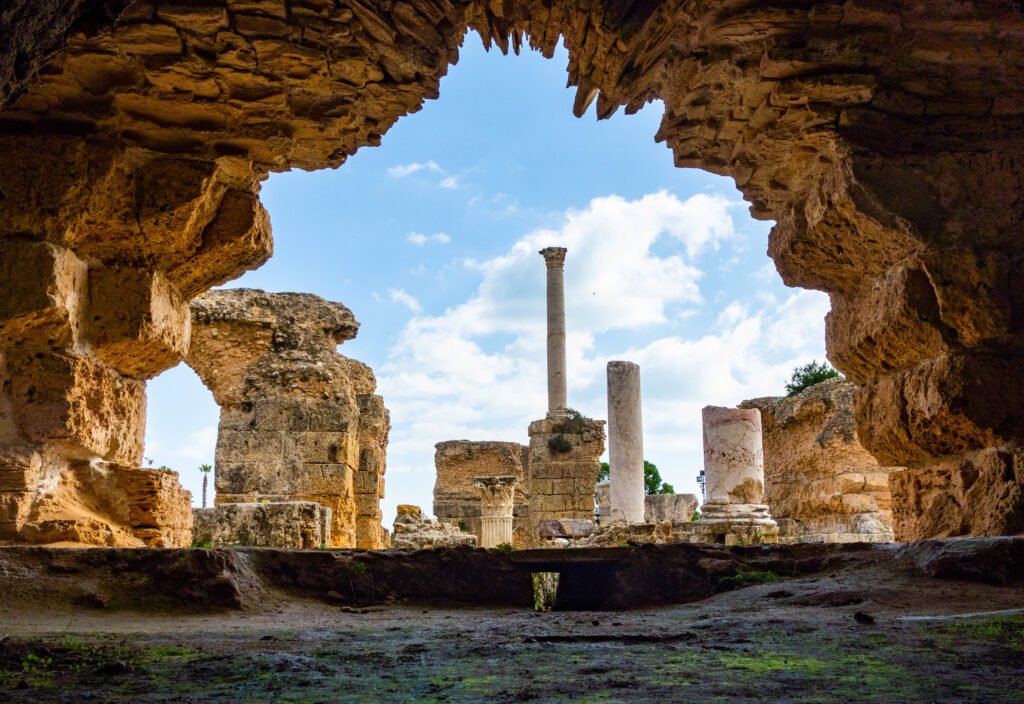
Today, Carthage welcomes guests into a realm rich with history and significance. Byrsa Hill provides expansive vistas of the ocean and the contemporary city, and its museum safeguards centuries of Phoenician, Roman, and early Christian history. The Antonine Baths stand like a grand postcard from ancient times, resonating with tales of imperial existence. The restored ancient Punic Ports now serve as tranquil basins, reflecting the maritime excellence that once defined the area. Each pathway, tile pattern, and pillar narrates a tale intricately linked to Tunisia’s essence.
Yet Carthage is more than just a relic of history, it embodies a vibrant aspect of the Tunisian spirit. Its influence is seen in textbooks, at cultural celebrations, in design styles, and within the collective national pride. Strolling through Carthage allows one to sense Tunisia’s rhythm through the ages; to observe how a remarkable civilization continues to influence a nation.
For tourists, a trip to Carthage is more than just sightseeing. Rather, it is a deep engagement with one of civilization’s most significant intersections. The blue ocean, the fragrance of jasmine wafting from nearby Sidi Bou Said, the charming villas of La Marsa, and the welcoming atmosphere of Tunis unite to form a remarkable experience.
With S.T.C.I’s Cultural Heritage Pack, this experience becomes even more rewarding. The pack caters to guests seeking more than just views. Instead, it is for those eager to grasp the narratives behind the rocks, the tales behind the scenery, and the legacy that influenced contemporary Tunisia. Our customized itinerary features Carthage, the lovely village of Sidi Bou Said, the Medina of Tunis, and other significant cultural sites, all led by enthusiastic experts who make history engaging.
Whether you are exploring Tunisia for the first time or reconnecting with your heritage, Carthage presents a portal to the nation’s profound cultural story. With STCI’s specialized cultural experiences, you can discover it in comfort, expertise, and authenticity; this is precisely as it should be experienced.
Carthage represents more than just Tunisia’s history; it stands as a vibrant symbol of the beauty, strength, and ingenuity that characterize the country today. Allow us to take you there!