January 28, 2026 |
A cultural bridge between North Africa and the Iberian world
Some chapters of Tunisia’s history unfold softly, like music drifting through an open window or light tracing patterns on white stone. One of the most graceful of these chapters comes from al Andalus, the former Muslim Spain whose legacy crossed the Mediterranean and settled gently into North African life. Over centuries, Andalusian families carried with them music, poetry, craftsmanship, and architectural traditions that blended naturally with local culture. Today, their presence can still be felt, especially in cities such as Tunis, Mahdia, Sousse, and Testour.
The Andalusian story in Tunisia began in the fifteenth and sixteenth centuries, when Muslim and Jewish families fled the fall of Granada and other Iberian cities. Many found refuge in Tunisia, bringing memories of Cordoba’s arches, Granada’s gardens, and Seville’s lively courtyards. Their arrival added layers of refinement and emotion to Tunisian society, enriching daily life with elegance, intellect, and a deep sense of artistic expression.
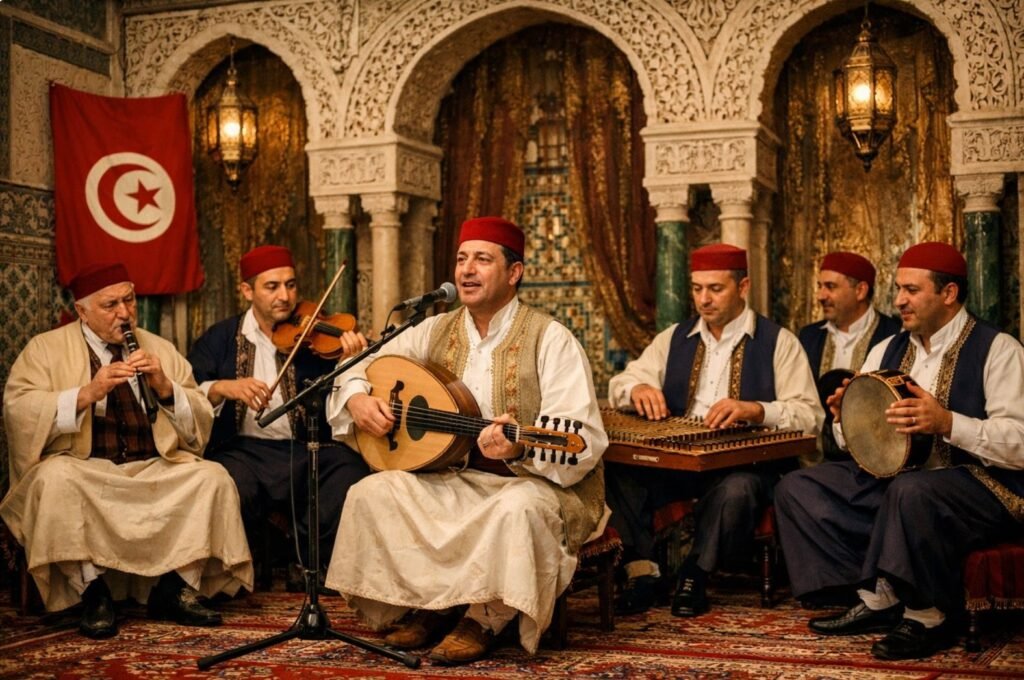
This heritage is perhaps most clearly heard in malouf, Tunisia’s classical musical tradition. Rooted in Andalusian origins and preserved through generations, malouf is built on poetic forms, rhythmic cycles, and emotional nuance. Performed with violins, oud, flute, cello, and percussion, it carries a gentle nostalgia for a lost homeland. Over time, it became inseparable from Tunisia’s own identity, cherished and celebrated across the country.
The town of Testour stands as a living reminder of this shared past. Founded by Andalusian families, its layout and buildings echo Spanish townscapes. The Great Mosque is especially striking, with its clock tower displaying numbers arranged backwards, a symbolic gesture that feels like time itself turning toward memory. Walking through Testour feels like moving between cultures that have learned to coexist in harmony.
Architectural traces of al Andalus appear throughout the medinas of Tunis, Sfax, and Mahdia. Many traditional homes feature inward facing courtyards with fountains, geometric tiles, and soft light filtering across whitewashed walls. Carved wooden doors, delicate stucco, and patterned balconies reflect a refined aesthetic that values balance, nature, and calm. These influences helped shape the Tunisian sense of beauty, one that feels both intimate and timeless.
Andalusian influence also found its way into everyday life. Ingredients such as almonds, cinnamon, and floral waters remain essential in Tunisian pastries. Social gatherings, poetic evenings, and certain wedding customs in the Sahel and northern regions still carry echoes of Iberian traditions. Over generations, these elements blended with Amazigh, Arab, and Mediterranean influences to create something uniquely Tunisian.
For travelers, discovering Andalusian Tunisia reveals a softer, more romantic side of the country. It is a journey through music halls, shaded courtyards, and towns shaped by memory and renewal. From the refined collections of the Raqqada Museum to concerts at Ennejma Ezzahra Palace in Sidi Bou Said, and from the elegant homes of La Marsa to the quiet streets of Testour, each place tells a story of continuity and creativity.
Through STCI’s Cultural Heritage Pack, travelers are invited to explore this legacy in depth. Our guided experiences introduce visitors to the world of malouf through concerts and workshops, and lead them through neighborhoods shaped by Andalusian architecture where history lives alongside modern life. Every stop is designed to offer insight, atmosphere, and a genuine connection to Tunisia’s layered past.
The Andalusian presence in Tunisia is not just history. It is a living bridge between two shores of the Mediterranean, shaping sound, space, taste, and identity. Tunisia carries this memory with elegance, preserving its melodies, restoring its architectural gems, and celebrating its spirit in everyday life. To experience this heritage is to understand Tunisia’s rare ability to turn history into living beauty, and to feel welcomed into a story that continues to unfold.