January 28, 2026 |
Berber villages, ksours, and ancestral traditions
In the deep South of Tunisia, where the desert meets the mountains and the sky stretches endlessly above golden plains, lies one of the country’s most captivating cultural worlds: the Amazigh heritage. Known to many as Berber culture, this ancient identity predates Carthage, Rome, and even the Arab conquests. It is a living testament to the first inhabitants of North Africa. They are people whose traditions, architecture, and worldview have shaped the spirit of southern Tunisia for thousands of years.
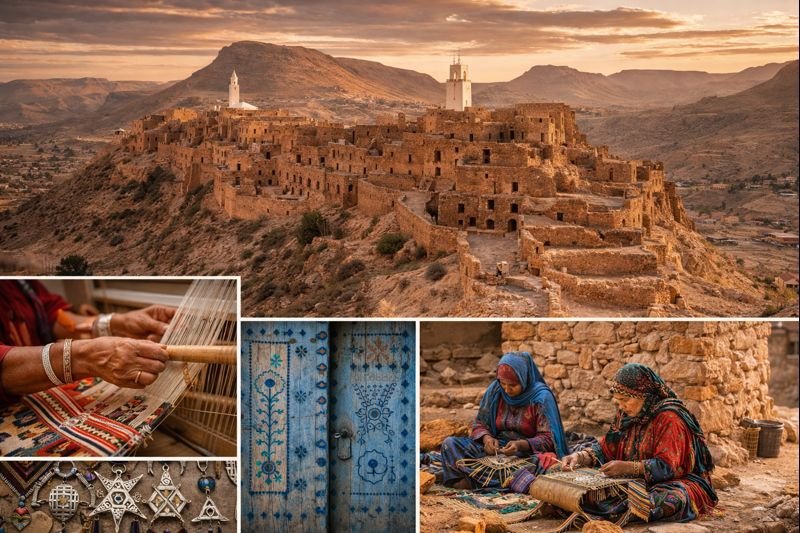
Travelers heading south discover a Tunisia that appears eternal, unrefined, and profoundly ingrained. Hamlets chiseled into slopes, stronghold-like granaries towering in hues of sand, and blue designs marked on timber doors illustrate a culture that achieved balance with the environment well ahead of contemporary roads arriving in these areas. The Amazigh influence is quiet yet deep, interlaced in everyday existence and conveyed through the stones, crafts, and tales of the South.
This heritage is most evident in the famous villages of Chenini, Douiret, and Tataouine. Situated on steep hills, these communities appear shaped from the land itself. The homes, constructed from stone, clay, and sculpted rock, integrate effortlessly into the environment. Previously, their high locations were crucial for defense, but now they provide stunning vistas of valleys and desert landscapes that shimmer at dawn and dusk.
Amazigh villages were planned with purpose and cleverness. Paths wind through groups of houses and shared areas, formed by centuries of adjustment to weather and landscape. Families constructed their homes around central courtyards that shielded them from heat and sandstorms. The design, both modest and clever, demonstrates a deep understanding of the environment and a strong regard for the community. Among the South’s most recognizable buildings are the ksours, the fortified storage facilities that previously held grain, oil, and valuable items. These ksours ascend like honeycomb citadels—tiers of arched rooms piled on top of each other, linked by tight passages and steep stairs. Ksour Oum Zriba, Ksar Ouled Soltane, and Ksar Hadada are outstanding representations of Amazigh creativity. Their design was both functional and communal: the ksar was owned by the tribe or village, with each family having its own ghorfa, or storage cell, identified by symbols inherited through generations.
These symbols—commonly rendered in blue or engraved in rock—are another essential aspect of Amazigh culture. Geometric designs, safeguarding symbols, and ancestral themes adorn doors, fabrics, ceramics, and jewelry. Every symbol holds significance: safeguarding, procreation, power, permanence. Observing these motifs offers a peek into one of the oldest artistic languages found in North Africa.
Amazigh culture is expressed not just through architecture and symbols. It exists in the customs maintained through everyday existence. In numerous villages, women can still be seen employing traditional weaving techniques, creating colorful rugs adorned with diamond patterns that reflect the tales of their forebears. Seniors recount tales of legends, champions, and traditional laws that previously ruled community existence. Festivals honor harvests, unions, and spiritual customs through music, drums, and dances that embody generations of cultural heritage.
The warmth of southern Tunisia’s hospitality also embodies Amazigh identity. Visitors are greeted with kindness, ease, and a feeling of togetherness that goes beyond eras. Sipping mint tea, savoring warm tabouna bread, or hearing tales beneath the desert sky forms memories that linger with travelers well after their departure. Discovering this region of Tunisia provides a deep understanding of the nation’s essence. It is an exploration of a heritage that is timeless and vibrant, influenced by strength, artistry, and a deep connection to the earth. With STCI’s Cultural Heritage Pack, travelers can explore this realm in greater depth and comfort. Our travel plans immerse visitors in the core of Amazigh villages, led by informed specialists who uncover the significance of symbols, the history of the ksours, and the customs still maintained by local families.
From the sculpted dwellings of Matmata to the elevated hamlets of Chenini and the legendary granaries of Tataouine, the Cultural Heritage Pack links travelers to the spirit of southern Tunisia. It caters not only to history enthusiasts but also to those in search of a connectionc . A connection with culture, with landscapes, and with the narratives that influenced an entire area.
The Amazigh culture represents one of the most exquisite heritages of Tunisia. It holds the recollection of old tribes, the insight of the desert, and the craftsmanship of numerous generations. Walking through these villages, feeling the stones of the ksours, or sharing time with the locals who inhabit them allows one to sense the ongoing essence of a heritage that remains vibrant in the South.
With STCI, this adventure transforms into a journey of genuineness and amazement: an exploration of one of Tunisia’s oldest and most enchanting cultural realms.